
Chundan Zhang, Ivana Borovská, Teona Iobashvili, Edoardo Morandi, Marta S.N. Lionnez, Oluwatosin S. Olayinka, John S. Schneekloth Jr., Massimiliano Clamer, Martin D. Witte, Klaus Pors, and Danny Incarnato
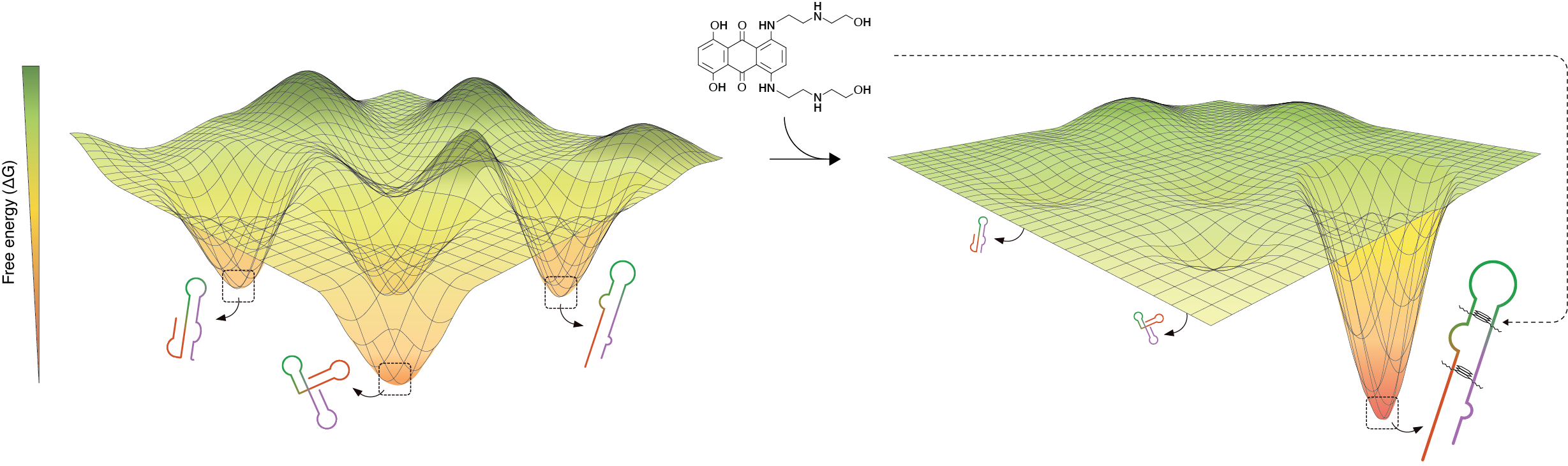
Targeting RNA with small molecules offers a transformative approach for modulating gene expression for disease targets that are currently deemed undruggable. Conventional screening strategies have traditionally prioritized
thermodynamically stable, low-entropy RNA motifs that adopt well-defined conformations, yet such regions offer limited energetic opportunity for small molecules to induce functional effects by altering RNA structure.
In contrast, many RNA molecules inherently sample dynamic ensembles of interconverting structures, providing a rich landscape where small molecules can in principle stabilize specific conformations or induce the formation
of alternative conformational states, thereby modulating function. Here, using group I self-splicing introns as a model system, we identified the antineoplastic anthraquinone drug Mitoxantrone as a potent RNA self-splicing inhibitor
(IC50 = 4.3 µM), capable of stabilizing a specific conformation within the structural ensemble of the T4 td intron. Quantitative structure-activity relationship analysis of a library of anthraquinone compounds showed that
the anthraquinone core alone is insufficient for functional modulation, and that the presence of basic amine-containing side chains is crucial to modulate RNA structural ensembles. Transcriptome-wide chemical probing analysis of
human cells revealed Mitoxantrone's preference for binding to GC-rich structured contexts, further showing that only a subset of bound sites undergo structural rearrangements. Furthermore, global analysis of 5′ UTR structural ensembles
uncovered a pronounced reduction in RNA structural heterogeneity upon Mitoxantrone treatment, resulting in increased translation efficiency, demonstrating that this compound can functionally reshape RNA conformational landscapes in living
cells. These findings provide mechanistic insights into the Mitoxantrone-mediated modulation of RNA structure and function and establish a framework for systematically dissecting RNA-small molecule interactions beyond binding, illuminating
new avenues for therapeutic intervention.
| SHAPE-MaP, RC files (RNA Framework-compliant) | Download | |
| SHAPE-MaP, DMSO-treated cells, Normalized reactivity XML files (RNA Framework-compliant) | Download | |
| SHAPE-MaP, MTX-treated cells, Normalized reactivity XML files (RNA Framework-compliant) | Download | |
| SHAPE-MaP, DMSO-treated cells, Structure models | Download | |
| SHAPE-MaP, MTX-treated cells, Structure models | Download | |
| 5′UTR-MaP, DMSO-treated cells, DRACO-deconvolved ensembles (RC files, normalized reactivity XML files & structure models) | Download | |
| 5′UTR-MaP, MTX-treated cells, DRACO-deconvolved ensembles (RC files, normalized reactivity XML files & structure models) | Download | |
| MM files (DRACO-compliant) | Zenodo | |
| diffShape | GitHub |